Gem & Jewelry Industry

Buckle Up; It's Going to Be a Bumpy Ride...


Buckle Up; It's Going to Be a Bumpy Ride...

COVID-19 and the International Gem Business

As the world continues to be on pause, I’ve checked in with everyone overseas to find out how my vendors and friends are doing.  My What’s App is constantly chirping with news from everywhere as people are home, bored and facing an uncertain future as gems are, after all, a luxury product.  Here’s the summary:

Africa

Antsirabe, Madagascar. Everyone is under stay at home orders. As my friend and supplier Gael put it to me: “All things stop. No customer, no work!! Very hard.” He’s also devastated because he had a sponsor to take him to the second largest mineral show in the world, Saint Marie Aux Mines in France, which is now cancelled.  Many of the mineral dealers sent their freight out earlier this year and that freight will now sit who knows where in France, racking up storage fees that nobody can pay.  

Meanwhile, the locals are allowed to go out between 5 a.m. and 11 a.m. to shop for essentials only.  Not everyone behaves but most people respect it.  As you can imagine, things like masks and latex gloves are not available.  Hand sanitizer is not something they are familiar with, and hospitals are not free.  You have to pay and if you don’t you will be turned away.  Testing is either rare or non-existent.  Whatever happens there in terms of the virus will just happen since the stay at home orders are only going to slow the inevitable.  Remember that in the US and in Europe, we are slowing the spread because we are preventing overcrowding in hospitals and improving treatment and testing.  That strategy makes little sense when there’s no testing and not much treatment.

Arusha, Tanzania. The situation there is much the same. Moustache, our broker, has no work.  Nobody can come into the country to buy gems.  Mining etc. is at a total standstill.  His daughter Brenda whose college we pay for is home with her grandma, waiting for things to start back up.

Nairobi, Kenya.  The same story, again, except there is slightly better availability of medical care and testing. My friend Doreen, who works at the University of Nairobi, told me that the University is closed for the rest of the term with online teaching only.  But, as you can imagine, that only works if you have a computer, or a phone, and can pay for the necessary internet connection.  So it’s not working well.  Doreen and her little boy went to her village in Meru.  She said she did get a paycheck and she’s hoping she will get another.  In the village, Doreen doesn’t have electricity but she’s away from the congestion of Nairobi and thus in a much safer place.

Europe

Frankfurt, Germany. My “little” sister (turning 40 next year) is recovering from her brush with COVID-19, getting sick leave and sick pay.  She’s pleased that she had it, “now that’s done with,” she says, and she feels safer.  Papa is at home in his house with a garden, for him it’s business as usual.  He’s home most of the time as he’s turning 80 this year.  He works in the garden, makes marmalade and bakes cake, uses his home trainer for 60 minutes and then the sauna on occasion.  He told me that at the local supermarket, where he goes once a week, the rule is that each person needs to use a shopping cart for distancing.  And they make 50 carts available, the rest are chained up.  So if there’s no cart, you wait outside, social distancing.  That way, you don’t need to count shoppers at the entrance.  He bought masks at home depot and has extra (because he’s that kind of guy).  

Hannover, Germany. Jochen from Jentsch minerals, my travel buddy, is at home, taking daily 6 mile walks with his Labrador.  Business is flat because most of his money comes from resale.  Pretty much all of the shows this year are or will be cancelled because by definition, they are mass gatherings.  And he’s not going to travel even if the ban lifts some time this year.  At 75, with diabetes, he belongs to a risk group and prefers to wait for a vaccine or at least better treatment options.  This sucks for me but it is obviously the right thing to do. We sometimes talk with the camera on, his hair and beard are growing wild, he looks like Santa Claus right now.

Moscow, Russia. An interesting situation is unfolding there with the government finally admitting that they have a problem.  My friend and supplier S. tells me that the wait for ambulances to get into the hospital is 9 hours.  A YouTube video was circulating in Russia showing how many ambulances are waiting in line.  https://youtu.be/d0VkYHcdIzo. The inhabitants are allowed outside within 100 meters of their homes, driving is not permitted except with special permission from the government, and you can walk outside only to get essential goods or walk the dog.  S. is getting requests for orders for high end material but obviously he can’t supply right now.  Russia is a complicated place when it comes to business.  The details are best left unsaid (insofar as I know them anyway), but S. has hunted for elk and gone fishing, and I know he has vodka, so he says he’ll be ok for a few months.  

The Far East.

Bangkok, Thailand. The trading centers are all closed, people under quarantine at home, business slowing to a halt. But some sources tell me that building owners are demanding rent and threatening to cancel leases, which is bad for the smaller businesses.  There are many fears that trade will not go back to normal anytime soon.  Nomad’s for instance has closed all of its offices (including New York), and they are not shipping out anything.  Cutting factories are closed, and even some of the material that is cut is not shipping out.

Hong Kong.  Some limited production there, but very limited from what I’m told.

Singapore. Lockdown, quarantine for everyone coming in (two weeks in a hotel, just like China and many other places) and only residents allowed.  My friend there is huddled up in her apartment in a high rise, waiting for things to change.  Testing and contact tracing are working well over there but like in every rich country, there is a poorer subculture of international workers living in poorer conditions, and for them life is not so easy.

And what about yours truly and co?

We are in the same position as a few weeks ago.  I have inventory, and I can get additional inventory from Dudley Blauwet, who is pretty much the only one shipping because he has access to his inventory.  Dudley usually supplies to jewelry stores and those are pretty much closed, so he’s taking naps for the first time in his life and learning how not to be in overdrive.  All the gem shows are cancelled for now – the earliest possibility for him to vend will be in August, and even that’s in the stars for now.  My friend Brett Kosnar (also in Colorado) is doing some recutting for me, his orders have otherwise dwindled, just like Dudley’s.  

I am doing some casting in Australia of all places.  Karen is working from home, cataloging our photos of finished jewelry and working on an extensive inspiration page with detailed information.  The catalog is also getting an overhaul.  Brandy is making CADs and I just sent four custom orders to Australia a week ago for printing and casting.  They should ship out this week.  Johanna can do the polish, Joanne and Johanna can do some soldering.  Supplies are available through Rio Grande and Stuller just announced that they will start shipping again, albeit only finished product, while supplies last.  Their supply chain, like most others, has crashed.  

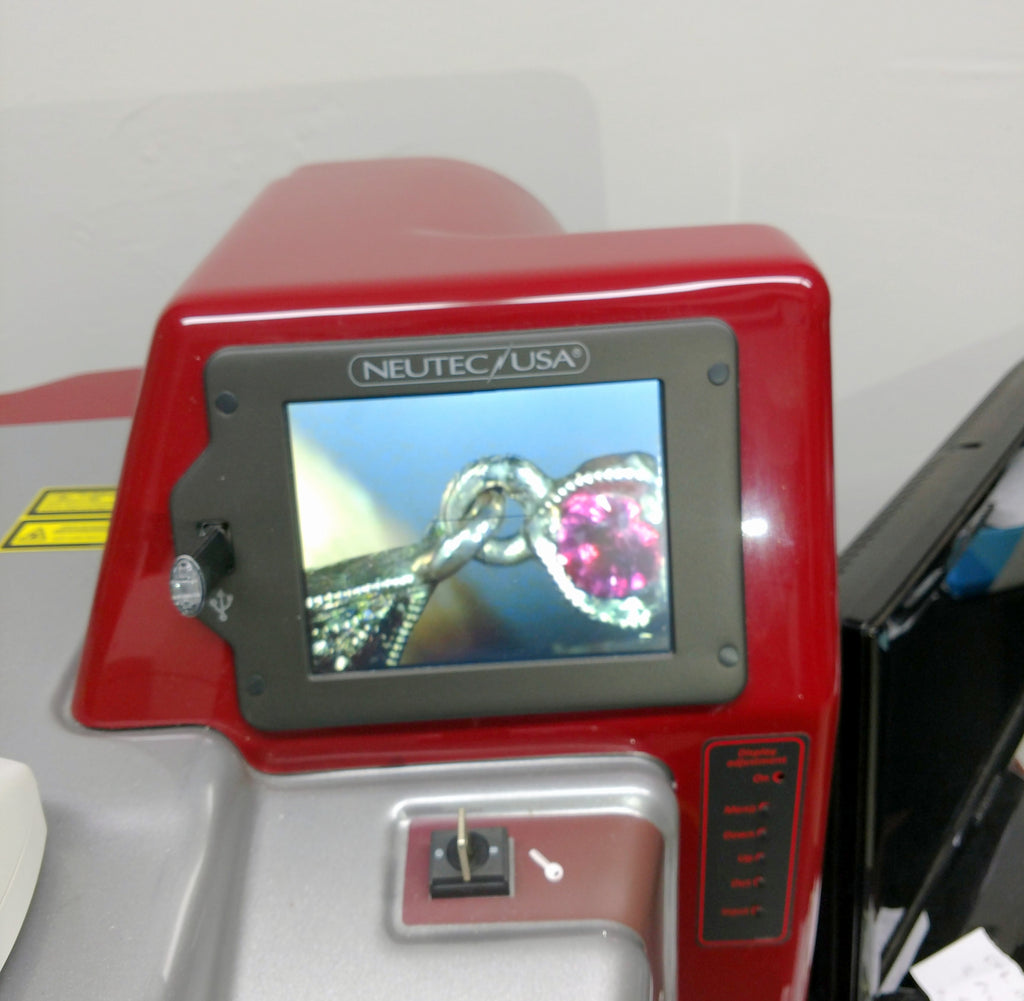
My missing links are rhodium plating for white gold – I can order from Rio but the basic setup with the solution is about 1K.  And I can’t do ring sizing because that’s done via laser solder.  The three people I know with a laser machine are all stuck at home and their laser is in New York.  Pierre, my setter, told me yesterday that he now has a bench setup at home as someone had an extra microscope that he could borrow (they cost 3K so you don’t want to buy one for just a few weeks).  He went to his office building last week, which is open, but no employees are allowed inside.  Since he’s self-employed and has no employees, he can enter his office, but he said he’s not going in for 2-3 small laser jobs because, like almost everyone, he’s driving rather than taking the subway, which is expensive with tolls and parking.  

The only thing we all love about this situation over here is the lack of traffic.  I can take my bike out and practice clipping in and out of the pedals without fear of getting run over (yesterday, I clipped out too late while stopping and kissed the asphalt in a parking lot – today I’m taking the day off, tending to my battle wound below the knee, and writing this blog).

My trainer Sebaj Adele, a 40-year cycling veteran, is probably bored stiff!  But with his gym closed, he’s patiently making do with his only trainee, sailing smoothly ahead, while the lumpier me, with mismatched biking gear, breathlessly follows the pro like an imprinted duckling.

Continue reading
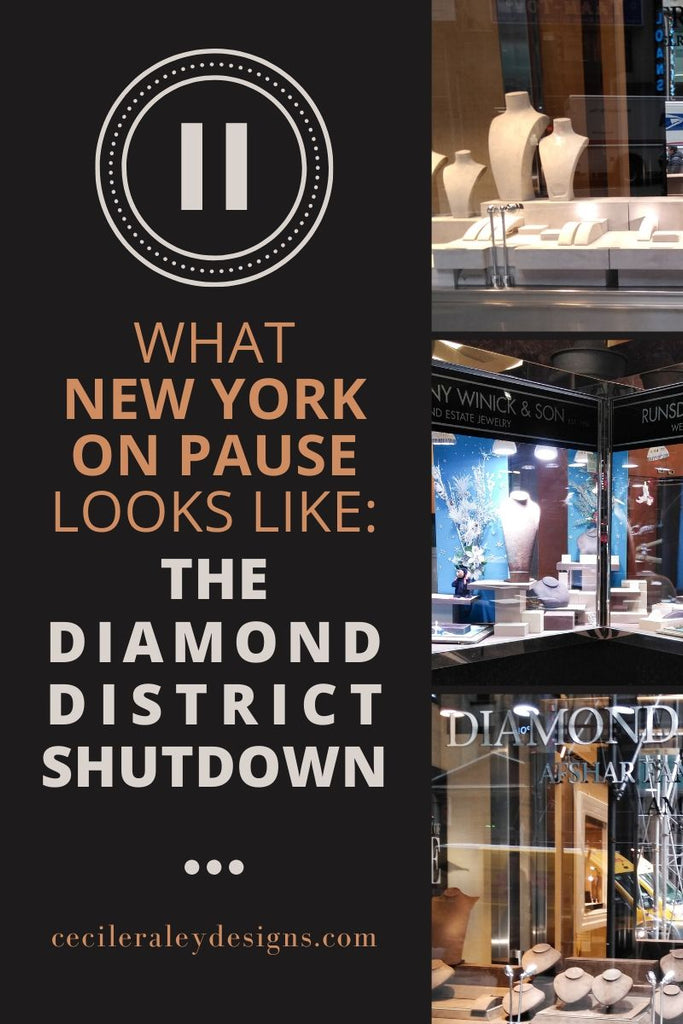
What New York City On Pause Looks Like: The Diamond District Shutdown

What New York City On Pause Looks Like: The Diamond District Shutdown

Covid-19 Week 2: How the Jewelry Industry is Coping with the Shutdown


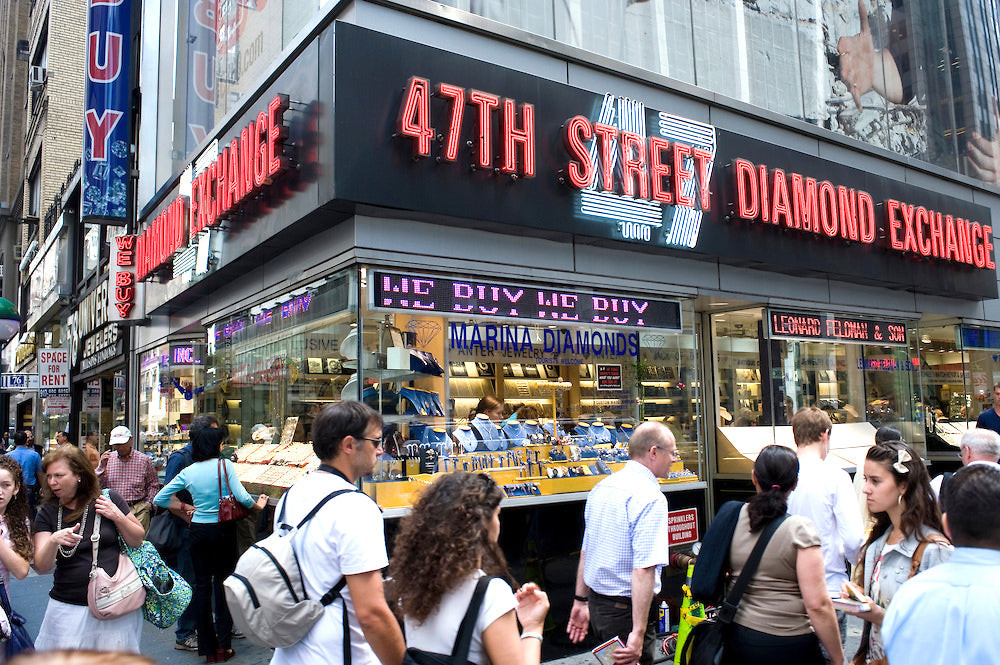
Empty Shop Window on 47th St

A week seems like a lifetime ago.  Does it feel like that to you, too?  Since my blog last week, all of the gem dealers in NYC have closed up shop, as has everyone else who doesn’t work from home.  This hits gemstone dealers especially hard because they cannot move their 5000 pound safe or a vault and just ship from home.  The buildings are locked up as well so whatever unfinished work was left in the hundreds or thousands of small workshops that make up the diamond district, it is going to stay there until things reopen.  All jewelers, engravers, setters, casters, polishers, etc. are unable to access their workbenches, safes filled with custom orders, equipment... and there’s no computerizing physical labor.  How do you solder or set remotely?  A few of my gold suppliers still ship, but most don’t because their offices are in NY and Long Island.  So, it’s all gonna have to wait.  How long?  Your guess is as good as mine.

Empty Shop Window in the Diamond District, NYC Empty Shop Window, March 2020, Diamond District, NYC

I spoke to several of my New York vendors and sub-contractors this week to see how they were faring.  The answers were all over the place.  The more established gemstone dealers will likely be fine.  Gems don’t spoil.  They have a lot of stockpiled goods that they can go through and grade in order to provide goods, and they too will be buying less so their expenses are down.  Many of them have jewelry store clients and, when those are closed, they don’t have to go to the office to fill orders, but they also don’t have to make purchases.  Dudley Blauwet, for example, usually makes a trip to Asia between the Tucson and Las Vegas Shows.  That fell through, so in lieu of buying, he is working up goods from his basement (big basement, lots of goods).  That will be fine in the short term, i.e. a few months.  Like so many of us, including me, he probably buys too many goods, just to keep the supply chain running and his family occupied.

 Those at the back end of the supply chain are far worse off.  From my friends in Africa I hear that most of them now have to stay home as well.  Doreen, my friend in Kenya who works as a Secretary at the University of Nairobi, took her little son George home to their family in the country.  She hopes to get paid next month, but that’s iffy.  I just sent her some money, and will do that again next week ($50-100 goes a long way over there).  My vendors in Madagascar are home idle.  Nobody is placing orders.  Jochen is making sure they are covered for now, and he sent money to our broker in Tanzania, whereas I covered their daughter’s tuition payment.  Right now, my personal expenses are down: no massages, hair-cuts, gym payments, restaurant dinners.  My money is better spent helping friends anyway.

Meanwhile, my New York sub-contractors who don’t have benches at home will have to wait it out.  Again, the most established ones will be ok.  They accepted decades ago that they cannot file for unemployment and that they are responsible for their own retirement.  In the 1980s, the diamond district was THE place to make money, and those who were smart set money aside.  Many (many) people in manufacturing are not native to this country and their upbringing provided no security from the government, so their mindset is different from yours and mine.  To them there’s only DIY.  One (unnamed party) told me that as long as the shutdown doesn’t last more than a decade, he’ll be ok.  Meanwhile, he’s just bored stiff because he likes working.  

At the other extreme, the younger crowd, is less lucky. They are still working on their nest egg and some of them have young children, even newborns.  Those who do CAD and have Rhino on their laptops (or can just buy it) can work remotely.  So I can keep Brandy busy – somewhat.  And my setter Ethan, whose wife just had a baby, had the foresight last summer to buy a second microscope (mind you that’s $3000) and set up a bench at home.  He still has a little work and I’m sending him more.  I have a few unfinished pieces and castings for stock items I meant to get to but didn’t.  He said he can work a little for a couple more weeks to supplement income, then he has to wait as well.  One step at a time.

And yours truly?  Well, my travel and purchasing budget for the next three months is going back to the kitty, so I can pay myself, Karen and Johanna.  We are staying positive, and you will see the fruits of our labor: better photos on the price list and in Etsy, an ordering form on the website, some social engagement like design and naming contests to keep you entertained at home at no cost.  There are many many gems to be photographed and listed, as well as more beaded stuff as I use up that stock, and I am still shipping every day.

On a more personal note, I bought seeds for my miniature garden and am going to tend to that with much love this spring.  I plan to take more gem videos or maybe a video of something else (dunno, maybe about design, or anything you’d like to know more about from me), string more necklaces, work on more CADs with Brandy, and on revamping the website.  Workaholics have to keep going!

Have a personal story to share?  Send it to us for our next blog.  We’re all in this together!

Continue reading

Travel or Not? Possible Plans and Some Corona Induced Industry Challenges

Travel or Not?  Possible Plans and Some Corona Induced Industry Challenges


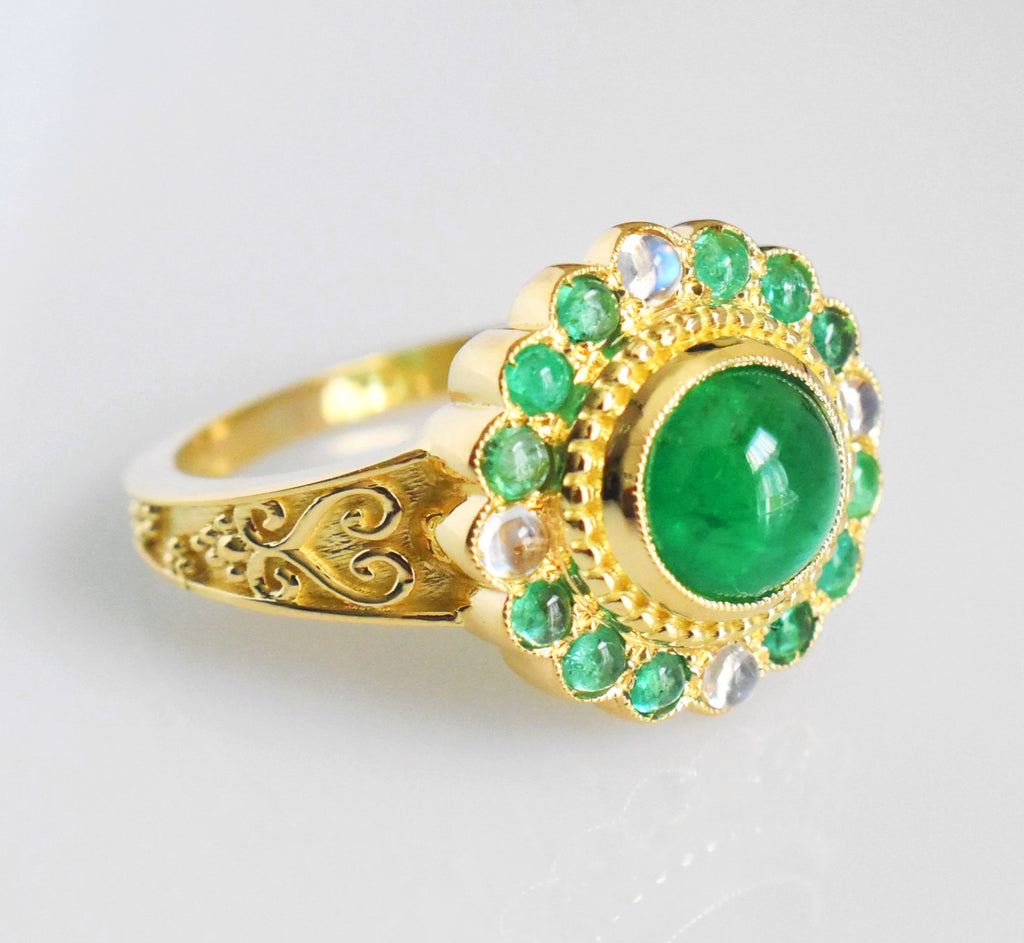
Ring Featuring Colombian Emerald from Chivor

So this was supposed to be a blog about my upcoming trip to Colombia.  And it largely is, but there are now some obvious qualifiers.  The flight is booked, paid for, Colombia is not on any list for travel caution, but things seem to change every day. 

Pendant Featuring Colombian Emerald from Chivor

If I do go, I will leave on April 2nd and will be back on the 13th.  There will be a buying weekend in Bogota, then a trip to Muzo and this time hopefully Consquez, after that Chivor.  My focus will be on getting Chivor material because it was so lovely.  Feel free to let me know if you have any requests -- and if the trip plans change, you will find out asap. 

Emerald Baguette from Chivor
Piazza at Vila de Leyva
Piazza at Vila de Leyva, in Colombia

My other big trip is planned for November. For now it’s just a plan, though it has pretty exact dates.  Nothing’s booked and I will hold off for a few weeks, see what develops.

The plan is that I will fly into Hanoi, Vietnam and visit the Lục Yên district, spending a couple of days visiting the mines there.  A very small gem market is located there, which may or may not have anything for me, but I want to check it out.  Lục Yên is also supposed to be quite beautiful.  I hope to be in a small group, with Jochen, his friend Klaus, and another couple of people.   

Yên Bái Province Where Lục Yên is Located
Yên Bái Province, Where Lục Yên is Located

From Hanoi, I would fly to Bangkok for some gem shopping.  Many of my suppliers have offices there, and since some of those I only see in Tucson, it would be fun to have the opportunity to purchase there with the chance to select from a potentially even larger quantity of goods.  I’d also like to do a trip to the northern part of Thailand.  

Gem Market in Thailand

 Again, we shall see.  As you can imagine, the gem industry, which relies on a lot of international exchange, has been quite disrupted by the virus.  Here are some of the direct impacts:

  1. The Hong Kong show, the second largest of the year, has been pushed down to May, and it’s unclear if it will even happen.  Many vendors who also do Vegas the first week of June have already decided to skip Hong Kong because it’s so close to the timing of the Vegas gem show and Vegas is more secure... at least for now.
  2. The Basel show has been cancelled.  Switzerland has decided to cancel all shows larger than 1000 people.  Any outbreak as a result of a show would obviously be a huge disruption of the infrastructure. 
  3. There’s some talk that the AGTA or the JCK in Vegas may even get cancelled.  Presumably there are already some people refusing to travel.  
  4. Gems by Nomads has an office in Milan, and there are shipping disruptions there.  Many of the other gem companies have offices in Bangkok, Hong Kong, and elsewhere so it’s making shipping and meeting difficult. 
  5. There’s dramatic slowdown of direct interaction between people in the far east, and friends of mine in Bangkok, Hong Kong and Singapore are all saying the same: very little foot traffic, fewer people meeting, and fewer sales.

My living near New York could prove lucky or unlucky.  I have access to almost anything I need gem wise, but we are also in a very crowded area.  

Anyway, sorry for the somewhat somber blog but I thought I’d update you on how things are.  Stay well!

Continue reading

Setting Secrets Exposed: What Happens to Your Custom Project in Setting

Setting Secrets Exposed: What Happens to Your Custom Project in Setting

I don't know if you have noticed but the diamond district tends to be very secretive about what happens behind all those closed doors. Try googling for articles on the diamond district, you will find that most have very little content. But for a little fun and very accurate information, try this article from the New York Times on Diamond District Slang.

Jewelers rarely if ever disclose who does their work, not even to each other. I think that's a pity because there's not only much to be learned for those not in the industry. I personally am in awe of some of the skill that is exhibited by jewelers, setters, engravers, and even polishers  who are least likely to get many kudos for their work. Each step in making these little masterpieces is the result of years of experience, and in most cases, also involves considerable financial investment, both in terms of equipment needed and risk management.  

Last week I made a little video to demonstrate some of this, and provide you some insight into one of the aspects of the jewelry making process: setting. As most of you know already, Pierre Berberoglu (you'll find him on facebook if you like to make friends) has been my setter for about 7 or 8 years now. Pierre started working in the jewelry industry at 14, back in Turkey at a time when Armenians didn't have many options of what jobs to pursue. Pierre, who also owns 4 Ben and Jerry's Ice cream shops, finds the work he does both challenging and soothing. He feels in control when he's at the bench, he says. And that despite the super expensive pieces he works on, many of which require not only a steady hand but also an enormous amount of concentration.

Our Ring Models Before Setting

Pierre's office can be found on the 8th floor of a well secured doorman building, and you have to be let into two doors to get in. There's a camera at the door and if he doesn't know you he will ask through the speaker who you are. If you are new, you can say who sent you or who recommended you, that might open the doors. Or not, if he deems it insecure. Pierre's safe has to protect a lot of client's projects so it's best not to deal with anyone you don't know.


Cecile Raley Designs job envelopes for custom projects


Your Cecile Raley Designs custom project will travel through the diamond district in a job envelope like this, with all important information written or sketched on the envelope

Pierre sits at his bench concentrating hard approximately 5-6 hours a day, the rest of the time is taken up talking to the likes of me, or dropping off and picking up a project. His huge microscope is a necessity for micro pave work, which he executes with perfection even while chatting with me.  

Trays of gemstones in my safe, waiting to be set into custom jewelry

In the video, we go over a few projects for clients, including one for me. I have him explain a bit about the challenges. While Pierre has been gem setting for nearly 40 years, the kinds of gems I bring are ones even he has rarely or never heard of. So for any new gem (i.e. the hauynes I started bringing three years ago) we have to discuss how it might behave under his tools. He told me once that setting paraiba melee is like setting soap bubbles. He almost doesn't use tools at all when he presses the prongs in (occasionally he uses his fingernails). I also have him set a lot of odd shapes, i.e. small pave ovals or squares, which is rarely done.  


A Cecile Raley Designs custom CAD design with a pave double halo of gemstones

Ethan, my other setter, who is also a bit more camera shy, so you aren't seeing him here, actually practiced setting colored gems for two years before we both felt comfortable working on my projects. Before going out on his own, Ethan set diamonds for a company that almost exclusively did micro pave for Tiffany's. While presenting it's own challenges (Tiffany's is a stickler for perfection), a setter who has set diamonds for years is usually very heavy handed and has to learn to hold back the force he uses for diamonds. This can result in a lot of breakage at first. And keep in mind that almost every setter in the US sets almost only diamonds. This makes what I do very much off the beaten path.

Dozens of custom projects in my Jersey City office, waiting to be taken to the NY diamond district, or just arriving back from there 

For a little extra entertainment, here's a short clip of Pierre discussing how he's setting a diamond tennis bracelet:

Detail of Hand Cut Scoop Down Pave by Pierre

Continue reading

Sapphire Treatments: What Matters and What Doesn’t  (By Yvonne Raley and Inken Krause)

Sapphire Treatments: What Matters and What Doesn’t  (By Yvonne Raley and Inken Krause)

Every month I give sapphires to my lab to certify that a sapphire is unheated, which is essential for my business, and important to my customers especially when they buy more expensive gems.  But determining that a sapphire is heated is not as easy as one might think.

First of all, what is the purpose of heating a sapphire?  Heating can improve the clarity of a gem, remove zoning, and intensify color.  With high enough temperatures (about 1700 degrees Celsius) you can also melt the silky inclusions in a sapphire.  When sapphires are cut, the friction created by the cutting wheel subjects the sapphire to some heat already (though in most cases, at that point the sapphire has already been heated) but this is rarely if ever detectable in a lab.

How do you determine heat treatment?  The first test to apply is to look at the inclusions of the sapphire under 10x magnification.  In the simplest case you see silky inclusions and fine dusty inclusions.  If those look undisturbed – read: not melted – then you can assume it is not heated.  This takes some practice of course, but in principle anyone can learn to do this (having a darkfield loupe helps because it provides nice lighting from the back). Feathers and jellyfish-like inclusions are also good indicators, it is only a bit more difficult to judge whether those are undisturbed. For a neat search engine of typical sapphire inclusions, go here: http://www.ruby-sapphire.com/ftir-intrigue.htm

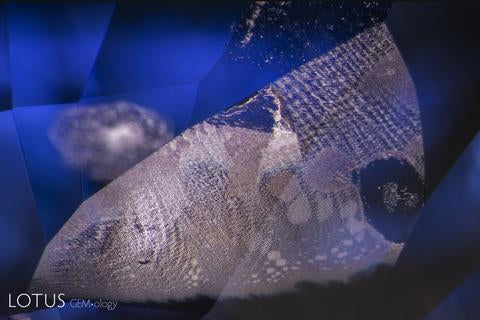
According to Lotus, "in this sapphire from Sri Lanka, evidence of high temperature heat treatment can be found in this moiré-patterned fingerprint. The once-lovely lacy pattern of liquid droplets is now besmirched by circular “explosions,” where the pressure from heating caused ruptures in the icroscopic negative crystals,..." (Photographed by Richard Hughes)Hughes, R.W., Manorotkul, W. et al. (2017) Ruby & Sapphire: A Gemologist's Guide. Bangkok, Lotus Publishing, 816 pp.; RWHL*.

However, this method is insufficient if the original gem is too clean to have enough inclusions in the first place: not every sapphire has enough inclusions and you need those to make your determination.  

A loupe clean gem therefore requires further testing.  A common second tool is a spectral analysis.  Heating a sapphire at high temperatures removes water from it.  A spectral graph will show the water content as a peak, and if this peak is lower, this is interpreted as the water having been eliminated by heat.  (https://assets.thermofisher.com/TFS-Assets/CAD/Application-Notes/D10280~.pdf)

From http://www.ruby-sapphire.com/ftir-intrigue.htm

There is a human factor here, however, as the strictness of interpretation here may vary from lab to lab.  In most if not all reputable labs, several people will look at the same gem and only if all conclude that they do not think they see evidence of heat will the gem pass as unheated.  GIA and Gubelin are examples of labs that always have 2 gemologists assess a gemstone 100% independently from each other, before examination results are compared and discussed, before potentially seeking advice from additional colleagues; at those two laboratories, the examining gemologists also do not know the client's identity.

Now, let me turn back to the original question, does it matter if a sapphire is heated or not?  Generally, 99% of sapphires on the market are heated, and heat treatment is standard.  According to AGTA standards, however, this must be disclosed on the invoice – in part because it can and usually does affect prices.  Heated sapphires can be up to 30% cheaper than unheated ones.  Sapphires that do not need heat treatment are much rarer than sapphires that do – or rather, sapphires that can be improved with heat treatment are the most common. 

In terms of integrity or safety for setting, however, it doesn’t matter that a gem is heated.  The treatment is permanent, durable, and does not otherwise affect the gem. (Inken and I actually differ a little on this assessment but I think this is the most common view).

As to our own shop, we try to carry mostly unheated gems, to which we have very good access.  Cecile Raley Designs specializes in the unusual gem – not the run of the mill stuff – so it makes sense for us to seek out unheated sapphires whenever possible.

Before closing let me add a quick note here about beryllium heated gems (industry calls this “Be-heat” and according to newer standards, this must be disclosed during a sale): this type of treatment requires heat treatment with beryllium, which reduces the blue tones in a sapphire, therefore it is used on yellow, orange or padparadscha like colors, but not on blues or pinks.  To detect beryllium, a 10x loupe is usually also sufficient since Be-heat leaves characteristic inclusions that are not like the natural inclusions of a sapphire – they are described as “little blue halos” in industry. 

Beryllium Heated Sapphire

From: http://www.yourgemologist.com/sapphireberylliumtreated.html

Here’s a quick link to a very interesting article on a synthetic Padparadscha sapphire: http://www.lotusgemology.com/index.php/library/articles/327-padparadscha-or-pretender-an-unusual-pink-orange-sapphire

(Inken Krause sells antique jewelry at https://www.einhoerning-jewelry.com.  She specializes in unheated ruby and sapphire.)


Continue reading

A traveler's report on the world of gems

A traveler's report on the world of gems

Michael Schmidt is a guest blogger with an honest inside look into the world famous "Diamond District" from a tourist perspective. He is an accomplished writer and has been my friend for over 30 years.  -  Yvonne Raley

http://www.freier-texter-frankfurt.de/

Continue reading

What does “recycled metal” really mean? What we do and don’t do when it comes to recycling

What does “recycled metal” really mean?  What we do and don’t do when it comes to recycling
This blog entry is prompted by a couple of recent questions about working with recycled metals.  For Cecile Raley Designs, “recycled” means something fairly simple: the casting service we use works with recycled metals.  They don’t use “only” recycled but they use them whenever they can.  That means, concretely, that the metal refinery that Taba Casting, our casting house, uses to purchase its casting grain, supplies mostly cleaned recycled metals.  Continue reading

Pave Setting - Hand Set versus Pre Cut

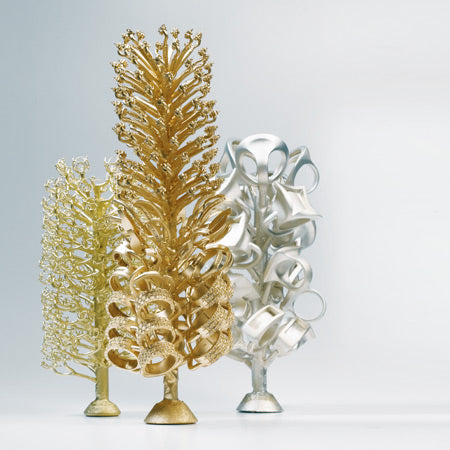
I thought I'd devote this blog entry to my why my setter Pierre has lost his hair.  Or so he says: by hand setting my tiny little and very soft glittery colored stones into hard metal castings that aren't ready made for the fast setting type that is the standard nowadays.
Let's first talk about how stones are set for commercial jewelry production. With most rings and other pieces nowadays being...
Continue reading
What Does "Recycled" Metal Really Mean?

I advertise in my shop that my castings are made from recycled metals.  Recently I got a question about what this really means, which made me realize that there is quite a need for me to clarify.

First off, here's what it doesn't mean: it doesn't mean that I re-purpose old clasps or chains or any other jewelry parts. All the items I use, unless they are antique (that is rare) are newly purchased...
Continue reading