Bogota 2026: Emeralds, Investments, Inflation


I was actually going on vacation in the Atacama Desert, Chile, on a farewell journey with my gem buddy Jochen Hintze from Jentsch Mineralien (closed as of 2024 because he will be turning 82 this fall). But my flight to Santiago was stopping over in Bogota both ways so I decided to add 3 gem shopping days in Colombia to my trip. In my five star Hotel (Hotel De La Opera in the Candelaria section), I was able to recover from 3 weeks in a small RV chugging through the desert. In Bogota, I went to the spa, got a massage and fancy food at T-Bone, while getting a feel for the current emerald market at the same time.

- Although I do love the neon bright no-oil emeralds one can get from the Ural Mountains in Russia, there’s something very special about the rich saturated Muzo greens and their blueish brighter counterpart - the emeralds of the sleepy little town of Chivor.
- 
See them in store here and here
The issue with buying emeralds in Colombia however, is treatment. Traditionally, almost all emeralds from Colombia used to be treated with cedar wood oil. These days, the oil can be replaced with more modern treatments such as baby oil, resins, opticon and other fillers. Not only do these need to be identified because they affect pricing; it's also important for the care of the gemstone. For example, traditional cedar wood oil has a tendency to dry out and cause fissures, so it needs to be repeated every decade or so. The more modern treatments don’t have these drawbacks.
If one wants to buy emeralds for the purposes of investment – i.e. to sell them a few years later for a higher price – then highly treated emeralds are not a good buy. When I buy Russian emeralds, I prefer to get no-oil or “insignificant” oil (as the AGL reports state) or “no evidence of treatment” as it says on the GIA report. I will also occasionally buy emeralds identified as containing “minor oil”.

In Colombia, however, the vast majority of emeralds are treated in one way or another, even F1 or minor treatment is a rarity. When I used to shop there in the past, this treatment was often very poorly identified and I would have to wait for a “verbal” from a small lab before I could confirm a sale. A “verbal” is the information you receive stated in verbal form without an identifying report. It is faster (24 hrs) and costs less. On this visit, however, I encountered more gems that were already certified with one of the available small Colombian laboratories. While these reports are not very useful in the United States when it comes to retail, for a wholesale buyer like me they are sufficient to know what I am buying. Once in the United States, I am able to recertify these gems with GIA or AGL so I can confidently pass this information along to the consumer in a form that can be verified. Labs from Colombia, while they can be very accurate, do not have much standing in the United States.
By way of getting a sense of current pricing, I usually go to the Emerald Trading center on the Avenue Jimenez de Quesada and stop at one of the booths near the entrance. I ask for the current pricing of low or no oil emeralds with report. That gives me a sense of the top end, especially if I don’t negotiate or say I am a wholesale buyer. I want to know what the tourists have to pay before I hit the sellers on a higher up floor where there are hardly any tourists, as well as the shops outside of the main area where fewer people shop.
Business for emeralds is actually fairly decent right now, I was told, which is surprising given how much inflation has affected the economy. On the other hand, the market for well known colored gems, such as Colombian emeralds (or blue sapphires for instance), is still constantly expanding. Colored gems still occupy only 5% of the market share of gemstone and diamond jewelry, but demand for diamond alternatives is always on the increase. More consumers are becoming aware of the fact that white diamonds, as well as treated diamonds and lab created diamonds, do not have any investment value. It is difficult to sell even a genuine and untreated white diamond on the secondary market for what one paid for it, even a decade or more later. I have done this twice for friends and relatives, and each time I was barely able to recover what they had spent at a jeweler's 10-15 years earlier.
Meanwhile, some colored stones have increased in value by nearly a factor of ten in the last 15 years (Mahenge spinel is an example): one of my suppliers still had an emerald available that they showed me in 2022, and now the price is double from what it was then. And 2022 prices were double from what they were during my first visit in 2019. So that’s a fourfold increase in 7 years.
Prices of many if not most natural colored gemstones (with little to no treatment) are therefore far outpacing current inflation of 3.5% or 5.7%, depending on which math you use. Here’s a good article that summarizes the issues with how inflation is currently calculated. https://www.forbes.com/sites/eriksherman/2026/05/02/forget-35-inflation-try-57-without-manipulation/
In 2022 alone, prices of certified no heat Burma rubies of one carat nearly doubled. Costs stabilized in 2023, but they never went down. In fact, with two exceptions that can be explained, I have never seen gemstone prices drop since I started my business in 2007. The first exception is tanzanite: in 2014 when Tanzanite One Mining Ltd (a major commercial mining operation) was sold, so many tanzanites were dumped onto the market that prices went down for a year or two. Tanzanite is still a fairly ubiquitous stone at a full 1/1000 the availability of diamonds. Diamonds are a mass market product, as is evidenced by the fact that one can buy them absolutely anywhere, whereas most jewelry stores will not be able to sell you a Colombian F1 emerald, a no heat blue Ceylon sapphire, or a Mahenge spinel. And Tanzanite is not very durable compared to sapphire and ruby, so it is not a highly coveted investment stone (you will find tanzanite jewelry to be more easily available than Mahenge spinel jewelry).
The second exception is cobalt spinel of medium quality, i.e. the lighter blue colors or the more grey blue colors, which in my opinion reached an all time high in 2022. Some companies have been conducting sales on this material, selling it for less than they did in 2022. However, there’s not been an overall downturn of the price, just a stabilization.
- 
Currently I own more cobalt spinel than I should, given that the price has not moved. But on the whole, all that means for me is that I should hold on to the material until it gains a wider market share, and then see how the value of my gems shakes out. Sooner or later the market will catch up. You can see the spinel pictured above in the store here.
By contrast, I bought two almost identical emeralds in Bogota in 2022, one of which I sold for a good profit in 2025, the second of which I held back and will now put out for sale at a higher price than its twin.
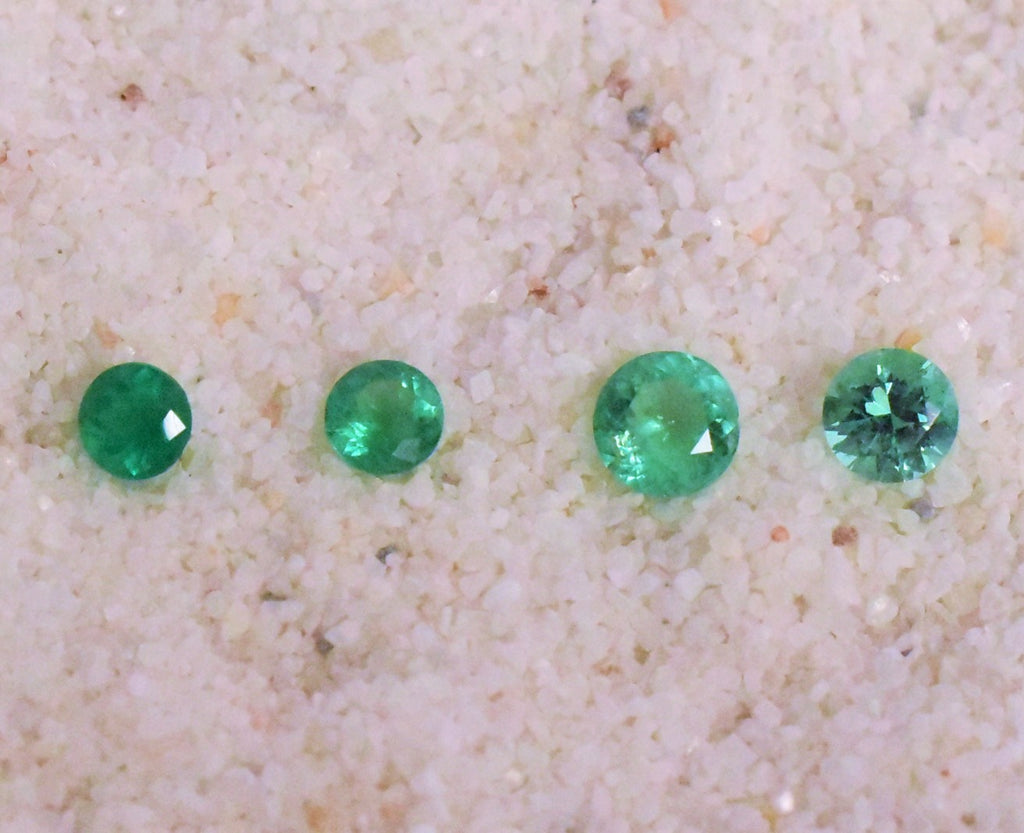
All the emeralds I bought from Colombia this time around were pre certified “minor oil” and what has not already sold will go for recertification with AGL and/or GIA. In the meantime, here are some images and videos for you to enjoy. Feel free to make inquiries.

-
Continue reading