
Gems

Demantoid 101: Origin, Color, Value

Demantoid 101: Origin, Color, Value
Demantoid Garnet is a gorgeous stone, isn’t it? It has such high dispersion that its diamond-like name is perfect for it. And of course the nicest Demantoid Garnet colors are sourced from Russia. The vibrant apple greens and emerald greens, as we call them in the trade, are not to be found anywhere else in the world. Namibian Demantoid tends to be  slightly lighter and more olive green than Russian demantoid (though it isn’t overly yellow). And the Madagascan stones, while warmer in tone than Namibian gems, are often overly dark with secondary browns. Both of these colors have their uses in designs as they can be blended with other more vibrant colors to offset or contrast them. But as a center stone or attention grabbing aspect of a jewelry design they are not ideal.

Russian demantoids only come from the Ural Mountains, not far from the city of Ekaterinburg, which itself is located pretty much in the middle of nowhere in this huge country. They are exported from there to Hong Kong or Bangkok, where they are cut and distributed. The number of vendors with the right connections that actually move the material out and get it ready for retail is very small. Maybe 3, 4 small businesses that I know of; they know each other and even work together as needed. Prices among them are comparable, and their color sorting is also the same.

Color availability ranges from a dark green that industry refers to as emerald green. It’s a dark but open color and a vibrant deep green, almost blueish although it doesn’t look anything like emerald (it looks close to tsavorite actually). The next lighter tone is usually referred to as apple green. It is my favorite color, though I also love the deeper and blueish emerald tones. Down the line from there are warmer and more olivy shades, all the way over to the more typical andradite color, a brown yellow tone that is actually extremely rare, but not valued very highly in the market.

Aside from that outlier, 80% of the production or more has olive tones in it, and only about 20% or a little less comes in apple and emerald green. Out of those two, emerald green makes up approximately one quarter. So in total, 5% or less of production is emerald green. And larger gems are (always) more rare than smaller gems. Practically the entire world’s production can be seen in Tucson at the GJX shows where the Russian vendors usually display.

Price wise, the emerald greens can fetch up to 10x the price as the other greens. Or more. In the melee sizes, prices are more fixed: the emerald greens are 2x the price of the apple green, 4x the price of the nicer olive greens and 8x the price of the more brownish greens (which I generally do not buy).

Generally demantoids are not treated, though there are heat treatments available for Russian stones that are sometimes used. So unless you have a cert, or direct information from the vendor, you cannot be sure any longer if they are heated or not. The heat treatment is with relatively low heat so it is less detectable in the lab.

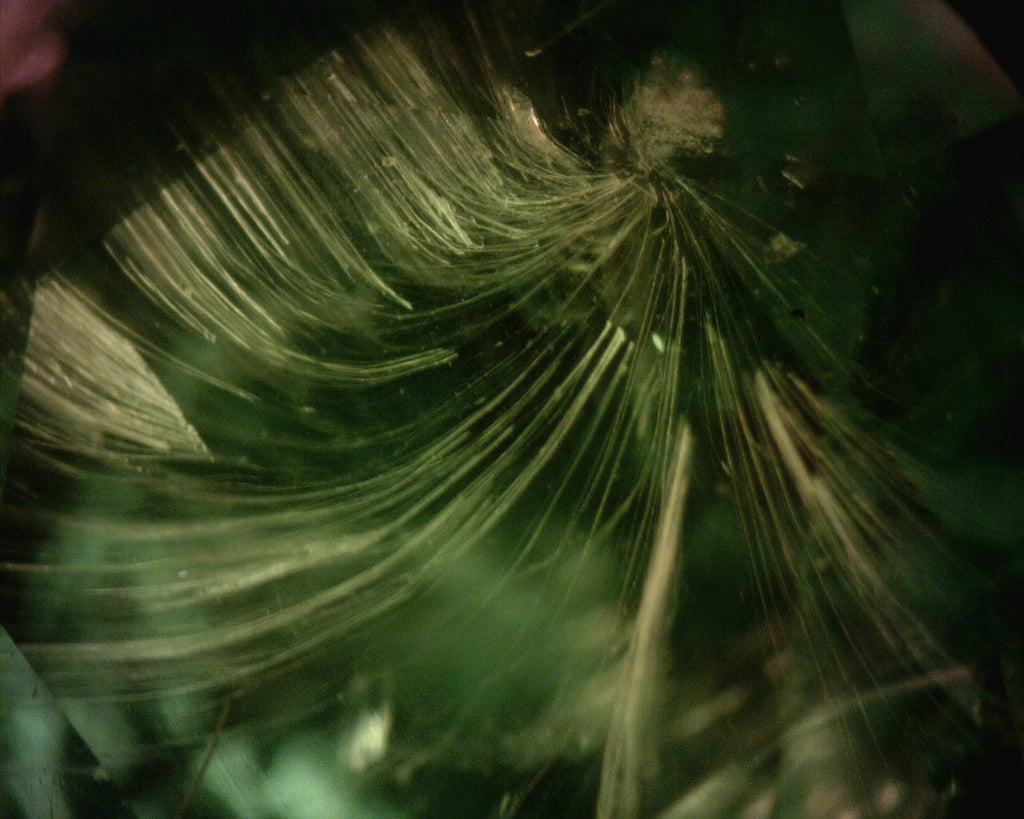
And what of the famous horsetail inclusions? Those are typical of Russian origin, and you can see bits of horsetails in most Russian demantoids even when they are small. Those inclusions, and the apple or emerald color, actually tell you with 95% accuracy where your demantoid is from so for small stones, you would not need a certificate.
Continue reading
Russian Demantoid: What’s the Deal with Horsetail Inclusions?

Russian Demantoid: What’s the Deal with Horsetail Inclusions?

As many of you know, I have been selling quite a few Russian demantoids on my site in the last year.  Initially they came from only one source, old stock, topping out at (exactly) 3.2mm, no heat, and a very bright medium apple green, no secondary yellow.  Super nice stuff, great cutting, all priced at $800/ct.  I still have some of that stock, but not much, and my source is out.  The price, as I said, is the price of older stock, and unless one finds a good connection, Russian prices are now much higher.

Demantoid Garnet

Three Colors of Demantoids

And then that’s just what happened.  I finally met another demantoid seller with reasonable prices in Tucson!  I found Sergey’s booth tucked away in the back of JCK, he was sharing the booth with someone, and he had only Russian demantoids, nothing else.  Sergey has a geology degree and taught at the University of Moscow for a while, then – Russian economy being what it is - decided to try himself at gems selling instead.  And he was very knowledgeable about his stones.  His stock was all well cut, ranging from an olive green to a rich deep forest green – I think industry calls it “emerald green.”  Although there is dispute, sometimes “apple green” refers to the darker color, sometimes not.  There is agreement though that the top stones should be bright, they should pop, and they should not have any yellow in them.  After a long discussion with Sergey and louping many of the gems, I was convinced that the material was legit – it’s a little easier to judge demantoids because you can tell a lot just by louping them and looking at the inclusions.  So I took the risk and purchased some pieces.  I first showed them to my other source in Tucson, it’s not something one likes to do but I just needed to know I wasn’t making a mistake.  Then I took them to the lab in NY.  Josh Lents, my colored stone guy at GAL, loved the colors and he explained a lot to me about how to judge the gems.

Demantoid Garnet, Kenyan Tsavorite

Demantoid and Kenyan Tsavorite

It’s funny in a way: Russian demantoid is the only gem – that I know of anyway – that is bought because of its inclusions, not despite them.  Demantoid inclusions are actually made of asbestos – so don’t chew on them I guess!  The typical horsetail type inclusion is only found in Russia (actually I’ve heard conflicting reports about this, but that’s the official story).  Not all gems have them, the smaller the piece the less likely it is that it has a horsetail.  But some gems have partial horsetails, and others have asymmetrical whispy inclusions that are also quite distinct.  I’m including some photos here, please inquire if you are interested in purchasing them.  They are getting listed on Etsy as we speak.

Horsetail Inclusions of Demantoid in the Photo

Aside from the Ural mountains in Russia, demantoids (named after the French “demant” for diamond), are also found in Namibia and Iran.  Namibian material is considerably more olive in color, though it also has some nice dispersion.  Iranian material is quite rare, even rarer than Russian.  Some of it is also apple green. 

Whispy Inclusions of Asbestos

What about treatment?  Some Russian demantoids are heated at 800 F to enhance color (that is considered low heat), but this treatment is undetectable in the laboratory.  So the best shot you have at knowing if the gem was heated is to know and trust your source.  The treatment is permanent and stable.

You can find some photos of finished jewelry with these demantoids on the pricescope thread here.

And here's a video of one of our gems: 

Continue reading